See Table 2-3 See Table 2-3 See Table 2-3 See Table 2-3 Go to Section 1.2.4 Closure Go to Table 2-3

2 Using EMDs in Site Management

EMDs can provide unique information at each stage of the project life cycle. In many circumstances, conventional data (including current and historical contaminant and geochemical data) are insufficient to make a planned technical decision in the project life cycle. Often, decision makers pursue traditional strategies because they lack sufficient data to support alternatives that could result in remediation of equal or greater efficiency at a lower cost and in equal or less time. EMDs provide additional and often unique information that supplements conventional data.

2.1 Introduction to Using EMDs

Table 2-1 summarizes the connections between conventional data and EMD data. Conventional data (for example, hydrogeological data, chemical, and geochemical analyses) often provide only indirect data regarding the mechanisms and rates of key attenuation or treatment processes. EMDs can complement these data by providing direct measurements of the organisms, genes, or enzymesAny of numerous proteins or conjugated proteins produced by living organisms and facilitating biochemical reactions (based on USEPA 2004a). involved in contaminant biodegradationA process by which microorganisms transform or alter (through metabolic or enzymatic action) the structure of chemicals introduced into the environment (USEPA 2011)., as well as relative contributions of abiotic and biotic processes and relative rates of various degradation processes. In addition, EMDs can be used to identify the source of contamination when several sources are suspected.The information that EMDs provide can improve estimates of attenuation rates and capacities and improve remedy performance assessments and optimization efforts. Improved understanding of the biological and nonbiological degradation processes also can lead to greater confidence in MNA or closure decisions.

Table 2-2 describes the benefits and limitations of the most common EMDs and how they may complement each other. One limitation among most EMDs is the limited standardization of QA/QC protocols; this is discussed more in Section 3.3 and Section 10. Table 2,  Introduction to EMDs Fact Sheet, provides a comparison of the EMDs, particularly in relation to availability and relative cost. The results and interpretation for each EMD method are presented in the individual method sections of this document. At times, different EMDs can provide similar information, so use care in selecting the most appropriate and cost efficient method (see Section 2.3 and the individual EMD method sections for more information).

2.2 Comparison of EMDs

In order to select among the various EMD tools available to assess site management activities and answer primary questions identified for the use of EMDs (see Section 2.3), decision makers must understand the difference between analyses that delineate the following:

In particular, an understanding of the direct connection between the information provided by a DNA-based analysis, RNA analysis, and stable isotopeTwo atoms with the same number of protons but a different number of neutrons.-based analysis is necessary to select appropriate EMD technologies.

2.3 Comparison of EMDs in answering primary questions

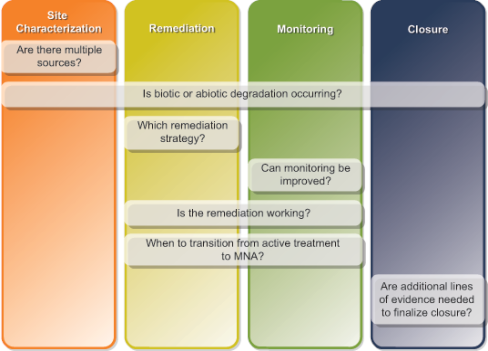
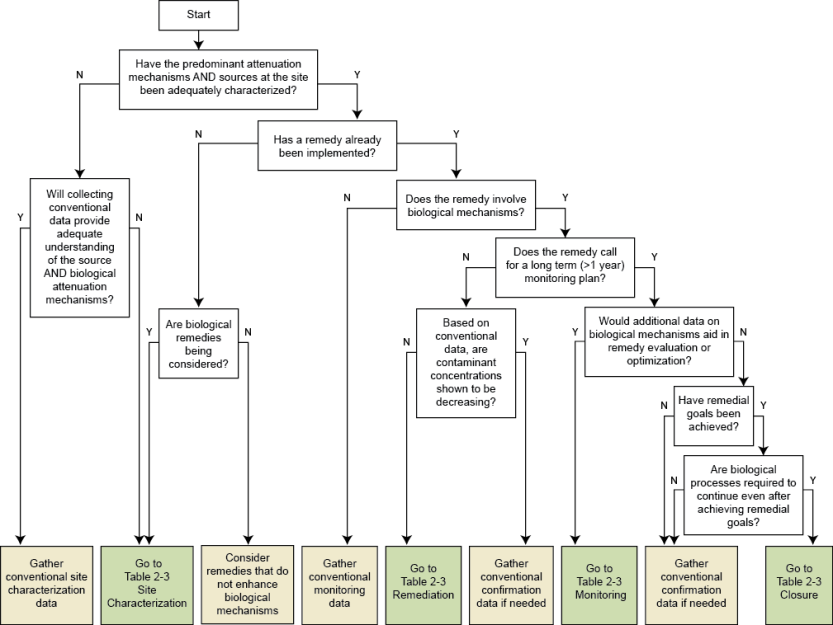
The first step in determining if EMDs can benefit an environmental management project is to determine if the conventional chemical and geochemical data leave a data gap that an EMD method can fill. Figure 2-2 provides an initial decision framework for beginning this evaluation and leads the user to explore additional options. Specifically, Figure 2-2 points to a section of Table 2-3 based on the phase of the project (site characterization, remediation, monitoring, or closure). Within the project phase sections of Table 2-3, several primary questions often arise as part of these project phases. An “X” indicates which EMDs can be used as a primary line of evidence to answer a particular question. However, the information generated by these tools is most often used as part of a lines-of-evidence approach to understanding the site.

2.4 Common Examples of EMD Uses

The following are a few examples of common situations where EMDs can be applied to supplement existing chemical and geochemical data to provide additional insight into site conditions and additional lines of evidence for site management decisions. Additional, detailed examples are located within each of the EMD sections.


Permission is granted to refer to or quote from this publication with the customary acknowledgment of the source (see suggested citation and disclaimer).


This web site is owned by ITRC.

1250 H Street, NW • Suite 850 • Washington, DC 20005 | P: (202) 266-4933 • F: (202) 266-4937

Terms of Service, Privacy Policy, and Usage Policy


ITRC is sponsored by the Environmental Council of the States